Showing posts with label G1. Show all posts

9.02.2009

Panasonic GF1 and the Future of m43

There's been a lot of exciting news in the non-SLR digicam world lately. Today, Panasonic officially announced the previously leaked and much anticipated GF-1. This is supposed to give us the autofocus performance of the G1/GH1 with the tiny size of the Olympus E-P1. Unlike the E-P1 also offers a flash, an electronic eye-level viewfinder (more on that later), and a black finish (in addition to red, silver, and white).
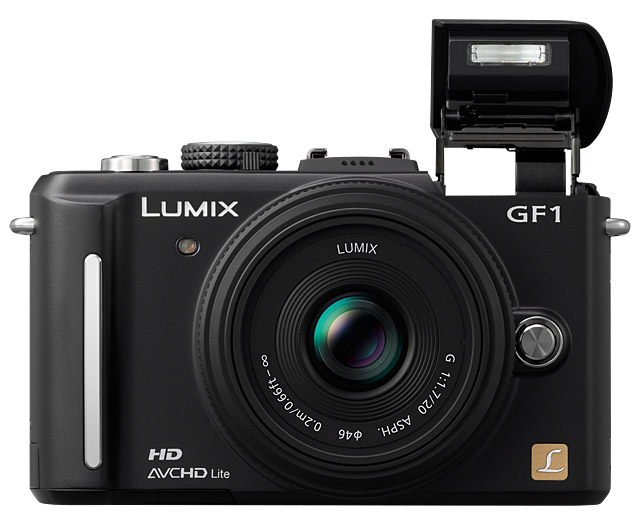
GF1k_front_popup.jpg

GF1k_back_LVF.jpg

It seems that Panasonic is putting a lot of energy into their m43 offerings... here's a list of the Panasonic-made components of their new system:

It seems that Panasonic has ceased development of new 4/3 (non-micro) cameras and lenses and put all their beyond-P&S energies into m43, so I'm excluding the existing 4/3 lenses (which don't AF as well when adapted anyway). The above list also doesn't include any of the Olympus m43 products. It's clear that Panny intend to make their system 'self-sufficient'. With all these nice prime lenses being announced, adapting M-mount rangefinder lenses to m43 cameras seems to be less and less relevant.

Sure, some of the lenses will be very expensive ($900 for the Leica 45/2.8 macro... ouch), but the prices don't seem as bad if you think of this as your primary camera system. A lot of enthusiasts (like myself) have mentally relegated m43 to 2nd-tier status behind DSLR systems. Sure, the m43 system has a long way to go before it will give us the flexibility of Canon or Nikon's vast array of lenses, flashes, and other accessories, but how many users out there actually use anything more than a handful of lenses (or just the kit lens + popup flash)? I love my Canon speedlights, but 90% of my DSLR shooting is done without them (and with 3-4 of my lenses).

GF1k_top.jpg

45_2.8_macro.jpg

A GF1 (or heck, even a G1) with a 3-lens 14/2.8, 20/1.7, and 45/2.8 kit (EFoV of 28/40/90) would be very sweet. Of course just a 2-lens 20/45 GF1 kit will set you back $2000 if you want to shoot at eye-level ($200 for the EVF). The non-Leica-branded 14/2.8 will likely be considerably less than $900, but the kit still pushes my price barrier for such a camera. This would all still cost less than a single 5D Mark II with no lens, but it's apples and oranges. It would be hard for me and many existing DSLR shooters to give up the high-ISO performance, great optical viewfinders, and extremely snappy performance that come along with those higher-end DSLR systems.

But as I've said before, m43 isn't necessarily for us enthusiasts (at least not exclusively). Panasonic themselves say they want to appeal to 20-30yr old 'active women' with the GF1. That explains the name ("Hey, maybe I should get my GF one.") The big questions that remain are:

  1. How good will the external viewfinder be? We already know a lot of photographers refuse to buy a camera at this price without an eye-level finder. We also know that the external EVF isn't nearly as good as the excellent ones in the G1 and GH1.
  2. Will the not-particularly-serious-but-serious-enough-to-want-something-more-than-a-P&S crowd want to spend $900 on a digicam when entry level DSLR kits with the same or better image quality are selling for $300 cheaper?

8.16.2009

E-P1 vs G1 Focusing Speed Comparison

I recently borrowed a friend's Panasonic G1 and did a little comparison with the Olympus E-P1. Here's a video (taken with the SD880) of the test. Kit lenses were used on both cameras.

As you can see, the G1 focuses quicker and quieter than the Olympus. When switching lenses around (not shown in the video), the G1's 14-45 seems to focus a bit faster on the E-P1 than does the Oly's own collapsible 14-42. Likewise, the Oly lens on the Panny body also focuses faster, but not as fast as the Panny lens on the Panny body. Most of the speed of the G1's focusing does come from the body.

6.24.2009

Hands-On E-P1 Account From an M8.2 User

Brad Herman has posted his First Impressions on the E-P1 over at RangeFinderForum. Brad's a current Leica M8.2 and former Pen F user, so he knows the premium compact space pretty well.

The big response to the E-P1 means more m43 bodies in the pipeline. My guess is that we'll see a larger body from Olympus, and a smaller body from Panasonic. What remains to be seen is how soon the "big 3" (Canon, Nikon, and Sony) will respond to this format. One "regular Joe" friend of mine says he loves his Panasonic G1 Kit (He came from a Casio Exilim). He's still on the learning curve, but was able to take good pictures straight out of the box. If more people discover this type of easier, smaller interchangeable lens camera, Rebel and Dxx sales might start to suffer.

It seems like Olympus wants to develop higher-end m43 bodies as well as more affordable ones. That should go a long way towards appeasing non-photographers who think the E-P1 is too expensive or photographers who think it isn't serious enough (mainly due to the lack of an eye-level viewfinder). On one side, I'm seeing plenty of people walking around with superzooms or other non-pocketable non-interchangeable-lens cameras, so it seems like there are plenty of users willing to give up the pocketability of ultra-compacts. On the other side, many "enthusiasts" (including myself) are picking up the E-P1 as a supplement to their larger "main" systems. They're not willing to give up the depth-of-field control, high-ISO performance, accessories, and overall image quality of their current systems. However, if Oly and Panny play their cards right, m43 could become more than a second system for the hardcore gearheads.

6.16.2009

The Pen Is Mightier

ep1front.jpg

Gussy it up however you want, Trebek. What matters is: does it work?

Olympus has mastered the art of the increasingly popular slow leak with the announcement of the new Pen E-P1. Pentax tried to make the "leaked" photos of their new K-7 more illicit-looking, but the build-up and pay-off of the E-P1 announcement has been incredible. The long and frenzied threads over at RangeFinderForum and the Fred Miranda Forums are your evidence.

I've ordered a product like this before (Sigma DP2). Wasted a pretty penny I don't mind telling you and if the Pen's iS (image stabilization) really works, I'll order a dozen.

The M43 Playing Field (with some competition):

Now that we have official specs, we can proceed with the inevitable comparisons with Panasonic's G1 and GH1. I've thrown in the Canon T1i and Pentax K-7 as well, since they represent different levels of the compact DSLR. The DP2 is in there to feel some shame.

Olympus E-P1 Panasonic G1 Panasonic GH1 Sigma DP2 Canon T1i (500D) Pentax K-7
Price

$800 with 14-42/3.5-5.6 lens (28-84mm EFoV) $900 with 17/2.8 pancake lens (34mm EFoV)

$700 (black) or $640 (blue or red) with 14-45/3.5-5.6 OIS lens (28-90mm EFoV) $1,500 with 14-140/4.0-5.8 OIS HD lens (28-280mm EFoV) $650 with fixed 24/2.8 lens (41mm EFoV) $850 with 18-55/3.5-5.6 IS lens (29-88mm EFoV) $1400 (est.) with 18-55/3.5-3.6 WR lens (27-83mm EFV)
Size 121x70x36 mm + considerably thinner than and approx 2/3 the volume of G1/GH1 124x84x45 mm 124x90x45 mm 113x60x56 mm (inc. lens) 129x98x62 mm 131x97x73 mm
Weight 410g body inc. battery 360g body inc. battery 385g body only (?) 280g body inc. battery and lens 520g body inc. battery 754g body inc. battery
Sensor 12.3mp (13.1 actual) 4/3" w/ 2x crop factor 12.1mp (13.1 actual) 4/3" w/ 2x crop factor 12.1mp (14.1mp actual) 4/3" w/ 2x crop factor + true multi-aspect sensor APS-C w/ 1.7x crop factor 15.1mp (15.5mp actual) APS-C w/ 1.6x crop factor 14.6mp (15.1mp actual) APS-C w/ 1.5x crop factor
Video 720p @ 30fps MJPEG (weak compression) None

1080p and 720p @ 30fps AVCHD or MJPEG

320x240 only 1080p @ 20fps 720p @ 30fps 720p (or 1080i) MJPEG (weak compression)
Stabilization In-body - not active during filming + works with all lenses In-lens + active during filming - each lens needs OIS In-lens + active during filming - each lens needs OIS None In-lens + active during filming - each lens needs IS In-body - not active during filming + works with all lenses
LCD Screen 3 inch - non-articulating - 230,000 dots

3 inch + tilt and swivel + 460,000 dots

3 inch + tilt and swivel + 460,000 dots

2.6 inch - non articulating - 230,000 dots - terrible

3 inch - non-articulating + 920,000 dots 3 inch - non-articulating + 920,000 dots
Viewfinder None (optional hotshoe finder w/ 17mm lens) Excellent EVF 100% coverage Excellent EVF 100% coverage None (optional hotshoe finder) Optical TTL 95% coverage Optical TTL 100% coverage
Built-In Flash? No Yes Yes

Yes (but very slow and weak)

Yes Yes
AF Assist Only w/ add-on Olympus flash units Built-in dedicated lamp (not flash strobes like many DSLRS) Built-in dedicated lamp (not flash strobes like many DSLRS) None (!) Yes, but uses annoying flash strobes. Built-in dedicated lamp (not flash strobes like many DSLRS)

EFoV is short for "equivalent field-of-view". Simply saying 'equivalent' is a bit misleading.

5.08.2009

Know Your Users - Micro Four-Thirds

Mainstream camera companies are pushing entry-level DSLRs "average consumer" as the answer to the mediocre image quality they get with the tiny sensors in their compacts. There's no doubt that these T1is, D5000s, etc. have great image quality, but are they really what these average consumers need?

Let me clarify what I mean by "average consumer". I'm not talking about enthusiasts who want a first DSLR. I'm talking about people, many with families, who want to capture their lives without becoming photographers. Sure, all DSLRs have "green modes" with auto-everything, but they're still essentially scaled back and less-good SLRs. These are great as entry points into vast systems or backups (or travel cameras) for those with higher-end cameras. My first DSLR was a Canon Rebel XTi, and it worked very well for what it was supposed to do.

The problem is that entry-level DSLRs are not necessarily the best tool for the aforementioned soccer-moms and hockey-dads. Let's start with the method of use itself. Many of these users are accustomed to shooting at arms length on their compacts. Optical viewfinders feel uncomfortable to them, and the ones in most entry-level DSLRs are extremely small. Lately, we've seen compact camera features like live-view in SLRs like the T1i and D5000, but these are tacked on and not particularly useful. Autofocus during live-view is either nonexistant or extremely slow, rendering the mode nearly useless for users who don't want to manually focus. Another SLR holdover is a preset number of focusing points. These users will rarely select focus points themselves, so why limit them to 7 or 9 points? Why not have a large-sensor version of AiAF that can analyse the whole scene and figure out what to focus on?

Clearly, some daring new ideas were needed. We're more likely to see daring designs from underdogs who have less to lose (and more to gain) by taking risks. Enter Panasonic and Olympus with Micro Four-Thirds. First out of the gate is the Panasonic Lumix DMC-G1. Now these consumer users can take pictures the way they're used to. A big screen, quick live-view focusing, a non-annoying AF-assist lamp, but with the same image quality as any entry-level DSLR. For up-to-the-eye shooting, the EVF is larger than the competing optical viewfinders. It even has overlays (rather than blinking focus points and symbols at the bottom) just like the rear LCD. The camera is even more compact than the competition and has the same kit lens choices (28-90 and 90-400 equivalents, both stabilized). Panasonic has finally succeeded where bridge point-and-shoots have failed repeatedly. Now we just need that 20/1.7 for indoor shots of the kids.

Of course I'm not the sort of user mentioned above and neither are most readers here, but the G1 also offers the full range of enthusiast features (RAW, configurability, P/S/A/M modes, etc.) as well. I'm still not sure if the DP2 is a keeper for me, but at the same price (a bit cheaper actually), the G1 is mighty tempting.